Sponsored article
What Affects the Grip of an Outdoor Entrance Mat After Rain and Snowmelt?
After heavy rainfall or sudden snowmelt, building entrances often become high-risk areas. A standard mat may remain firmly in place, yet the first steps taken across its surface can still feel noticeably unstable. Moisture from footwear combined with accumulated dirt creates a smooth film that immediately reduces traction. Effective dirt and moisture control requires properly designed entrance mat systems.
Read more: The use of entrance floor mats in hotels: the key to aesthetics and functionality
Footwear Contact and the Importance of Water Drainage
The slip resistance of an entrance mat depends primarily on direct contact between the shoe sole and the mat’s textured surface. Water and fine dirt particles create a separating layer that behaves much like a lubricant. When moisture is not removed efficiently, the sole begins to slide on a thin film of liquid instead of gripping the textured surface beneath it.
Read more: How can a law firm support SMEs in the face of AI regulations?
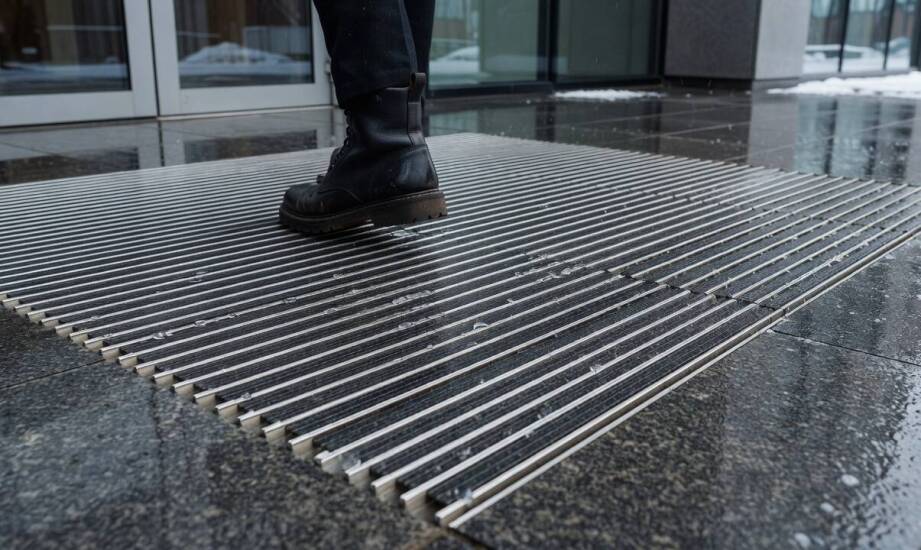
This issue is addressed through high-capacity entrance systems designed for outdoor use. Open-profile structures with perforations or drainage channels direct water beneath the mat or away from the walking surface. As a result, the active surface remains relatively dry even during prolonged rainfall. Strong frame edges also help stabilise the mat and reduce the risk of movement under dynamic foot traffic.
Read more: Custom Mats – The Perfect Solution for Office Spaces
A properly functioning drainage system significantly reduces water accumulation at the entrance, helping to improve pedestrian safety.
Why Slush and Road Salt Create Greater Challenges
Winter contaminants such as slush, melting snow, and road salt often reduce traction more aggressively than rainwater alone. Dissolved salt creates a dense solution with particularly low friction, while sand particles and tiny ice crystals can behave like microscopic rollers beneath footwear.
If the outdoor cleaning zone fails to retain this mixture, moisture is quickly carried onto smooth interior floors. Once deposited, this contamination tends to remain on hard surfaces much longer and is difficult to remove by simply wiping shoes.
Professional entrance systems equipped with brush inserts or durable rubber cleaning elements are generally more effective in these conditions. These components mechanically break up compacted slush and dirt while directing contaminants into the collection area below the mat. As a result, the next user encounters a cleaner and more stable walking surface.
How Frost Influences Material Flexibility
Low temperatures can significantly stiffen ordinary rubber compounds and lower-grade plastics. As a result, the entrance mat becomes less capable of adapting to changes in foot pressure and uneven loading.
The small deformations that occur under normal use play an important role in maintaining traction. Some advanced polymer compounds, including EPDM-based materials, can retain flexibility at lower temperatures better than many conventional rubber materials, helping maintain performance in winter conditions.
When materials become excessively rigid, they may lose elasticity and become more susceptible to cracking over time. In practice, this can reduce grip, particularly on uneven entrance surfaces or heavily exposed outdoor areas.
Flexible materials are often better able to accommodate minor surface irregularities and may help break up thin layers of ice that form on walking surfaces.
How to Assess Real Slip Resistance
Claims regarding slip resistance should always be verified through relevant testing and certification data. Different standards evaluate different performance characteristics under specific conditions.
For example, the European standard EN 13893 focuses on the coefficient of friction for dry flooring conditions. While useful, it does not fully represent performance during rainfall or snowmelt. Other standards, such as the German DIN 51130 classification system, categorise walking surfaces into slip-resistance classes ranging from R9 to R13.
Outdoor entrances that are regularly exposed to rain and snow often require materials that offer enhanced slip resistance. In many commercial buildings, weatherproof entrance mats are evaluated using additional testing methods that simulate wet conditions.
Wet pendulum testing, for example, assesses the interaction between a moving heel and a wet surface, providing a more realistic indication of slip performance in real-world environments.
Aluminium Entrance Mats During Rainy Weather
Modern aluminium entrance systems combine rigid structural profiles with carefully selected cleaning inserts. In many commercial installations, aluminium profiles connected with stainless steel cables and EPDM spacers create an open structure that allows water and debris to pass below the walking surface.
This design promotes drainage while trapping mud, sand, and moisture beneath the mat. Regular cleaning of the collection chamber helps maintain drainage performance throughout challenging seasons.
Rubber inserts can effectively remove heavier dirt from shoe treads, while the open channels between aluminium profiles help reduce water accumulation. High-quality aluminium systems are also known for their durability and ability to withstand heavy pedestrian traffic, trolleys, and wheeled equipment without significant deformation.
Proper installation remains essential. Excessive clearance between the mat and recess may result in unwanted movement, noise, and reduced user comfort.
Combining Traction and Moisture Management
An outdoor entrance system performs effectively only when it combines reliable traction with efficient moisture removal. Without a drainage mechanism, even an aggressive cleaning surface can quickly become covered with a slippery film of water and dirt.
Likewise, insufficient structural rigidity may allow edges to deform, increasing the likelihood of trips and instability at the entrance.
The overall safety of an entrance area depends on selecting suitable aluminium profiles, cleaning inserts, and installation methods for the expected traffic volume and environmental conditions. Unimat Factory manufactures entrance mat systems designed for commercial and public buildings, where durability, cleanliness, and user safety are key considerations.
A carefully engineered combination of materials helps maintain walking comfort and traction throughout changing weather conditions.
Traction decreases when water and dirt create a slippery film between footwear and the mat surface.
Open structures, perforations, and drainage channels help keep the active walking surface drier.
Slush and road salt can reduce friction more aggressively than rainfall alone.
Cold temperatures may stiffen lower-quality materials, reducing their ability to adapt to foot pressure.
Real slip resistance should be assessed using relevant standards and test methods rather than marketing claims.
Aluminium entrance systems combine structural stability with water drainage and effective dirt removal.
An effective outdoor mat must both maintain traction and manage moisture efficiently.
FAQ
Why can a mat become slippery even if it is well made?
The most common cause is the build-up of water and dirt, which creates a thin layer between the shoe sole and the mat surface. Even a durable mat can lose effectiveness if moisture is not drained away properly. This can make the first steps less stable, particularly during periods of heavy foot traffic.
Which construction features improve the safety of an outdoor entrance mat?
Open structures, drainage channels, and rigid edges are among the most important features. Cleaning inserts such as brushes and rubber profiles also help by mechanically removing mud, snow, and debris from footwear. This allows the walking surface to maintain traction for longer.
What should be checked when evaluating slip-resistance claims?
It is important to determine whether the stated test applies to dry, wet, or dynamic conditions, as these represent very different scenarios. References to recognised standards and laboratory testing provide a much more reliable indication of how a product will perform during rainfall or snowmelt.
Article categories
You might be interested

Cassock as an Element of Clergy Identity: Its Functions and Significance

How Do Cut, Fabric and Finish Influence the Comfort and Symbolic Meaning of a Stole?

How can a law firm support SMEs in the face of AI regulations?