Sponsored article
How Do Cut, Fabric and Finish Influence the Comfort and Symbolic Meaning of a Stole?
- Length, Width and Weight: Their Impact on Fit and Drape
- Fabric Choice and Performance During Frequent Use
- How Lining, Reinforcement and Embroidery Help Maintain Shape
- Caring for a Stole to Preserve Its Shape for Years
- Embellishment and the Visibility of Liturgical Symbolism
- The Importance of Choosing the Right Liturgical Vestment
- Key Takeaways
- FAQ
Daily priestly or diaconal ministry means that every element of liturgical attire should be comfortable, functional and appropriate for its role. In practice, even small differences in construction can significantly affect both wearing comfort and the way a stole presents its symbolic meaning.
Read more: Cassock as an Element of Clergy Identity: Its Functions and Significance
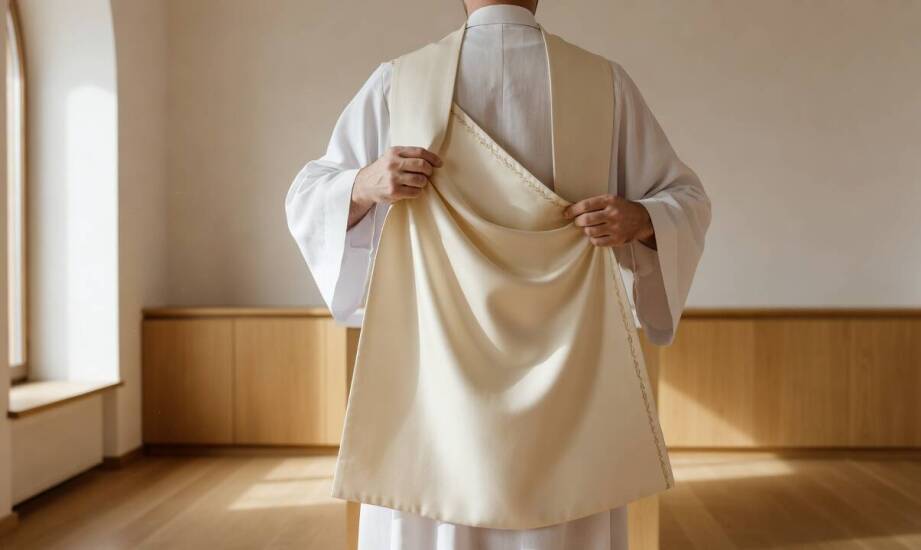
A stole is worn over an alb or surplice and should never interfere with walking, kneeling or raising the hands during liturgical actions. Poorly shaped fabric may restrict movement or shift out of place, distracting the celebrant. For this reason, fabric properties and garment construction play a crucial role.
Length, Width and Weight: Their Impact on Fit and Drape
A commonly used priestly stole measures approximately 130 cm from the shoulder downward. Its width generally ranges from 13 to 16 cm.
These proportions help the fabric fall naturally along the chest without extending excessively low. However, these dimensions should not be treated as a universal standard. They depend on the workshop’s design approach as well as the height and build of the wearer.
A stole that is too short can disrupt the proportions of the vestment and may lift awkwardly during broader gestures. One that is too long can make movement around the altar less comfortable and require frequent adjustment.
The weight of the fabric also influences stability. Heavier materials tend to maintain their shape more effectively during kneeling, walking and processions, while lighter fabrics may move more freely during active use.
Deacons wear this vestment diagonally, running from the left shoulder to the right side of the body. Diaconal models are often around 130 cm long and 13–14 cm wide. Their specialised cut helps prevent the fabric from slipping during ministry. Some designs also include discreet fastenings or cords for additional stability.
Fabric Choice and Performance During Frequent Use
Natural silk offers a refined appearance, lightweight feel and elegant sheen. Its breathable structure can be particularly comfortable during lengthy celebrations in warm environments.
Wool and wool-blend fabrics provide excellent temperature regulation. They manage moisture effectively and allow good airflow.
Synthetic fibres such as polyester or polyester-wool blends are generally more resistant to creasing, making everyday care easier. However, synthetic fabrics may not always drape as naturally as fibres of natural origin.
Natural fabrics move more fluidly with the body during liturgical actions, while synthetic materials often retain their shape better after repeated folding and storage.
The choice of fabric usually depends on how frequently the stole will be used. Daily ministry often requires durable materials with good resistance to deformation, whereas occasional solemn celebrations may allow for more delicate silk fabrics.
How Lining, Reinforcement and Embroidery Help Maintain Shape
A well-constructed lining made from a fabric of similar quality helps protect the edges from stretching and distortion. It also reduces the effects of moisture and everyday wear.
Additional reinforcement around the neck area helps prevent premature abrasion and maintains a balanced line across the shoulders.
Embroidery serves both decorative and practical purposes. Large embroidered motifs can influence the weight distribution of the stole, which is why their placement should always be carefully considered.
Different tailoring workshops adapt their products to the specific needs of clergy. For example, Ars Sacra offers both Gothic and Roman-style vestments designed for different liturgical preferences.
The variety of available stoles and the possibility of extensive customisation allow clergy to adapt the width, shape and finishing details to their preferred way of wearing the vestment.
Many models available on the market incorporate Eucharistic motifs, Marian symbolism or images of saints, offering both visual beauty and liturgical significance.
Caring for a Stole to Preserve Its Shape for Years
Proper care after use can significantly extend the lifespan of liturgical vestments.
Excess moisture should be removed gently. Drying should take place either flat or in a well-ventilated area. Direct exposure to intense sunlight should be avoided whenever possible.
Ironing requirements depend entirely on the fabric type and finishing details. Excessive heat may damage fibres, while temperatures that are too low may fail to remove deeper creases.
For best results, ironing should be done through a thin cloth, preferably from the reverse side of the fabric and away from delicate embroidered areas.
Storage practices are just as important as cleaning. Depending on the fabric type, a stole may be stored hanging or rolled in a way that prevents permanent creases.
Traditional folding can create stubborn marks that are difficult to remove. Silk, velvet and heavily decorated pieces often benefit from professional cleaning and specialised storage methods.
Regular and thoughtful care helps preserve colour intensity and structural integrity for many years.
Embellishment and the Visibility of Liturgical Symbolism
Rich embroidered decoration depicting a chalice with a host, ears of wheat, grapes or the IHS monogram serves a theological purpose.
These motifs reinforce the symbolism of ordained ministry and reflect themes present in the liturgy itself.
Solemn celebrations often allow for more elaborate decorative elements, while simpler designs featuring only a subtle cross may be better suited to regular daily ministry, where practicality and ease of use are especially important.
Excessively heavy decoration can reduce comfort during frequent use. On the other hand, overly minimalist designs may diminish the visual expression of liturgical symbolism.
Finding a balance between ornamentation and fabric flexibility is essential for long-term comfort and functionality. Embroidery workshops often adjust thread thickness and construction techniques to maintain both aesthetics and ease of movement.
The Importance of Choosing the Right Liturgical Vestment
Selecting the right stole involves evaluating several important factors.
The fabric structure, style, finish and intended use should correspond to the requirements of parish life and the personal preferences of the clergy member.
A well-made stole accompanies the celebrant throughout the liturgy without causing unnecessary discomfort.
Understanding the physical characteristics of individual materials makes it easier to choose a vestment that combines centuries of liturgical tradition with the practical demands of everyday ministry.
Key Takeaways
Small differences in a stole’s cut can significantly affect comfort and the presentation of liturgical symbolism.
Length, width and fabric weight influence how the stole drapes and moves during liturgical gestures.
Wool and wool blends generally provide excellent shape retention, while silk offers lightness and elegance.
Lining, reinforcement and embroidery help maintain structure and reduce deformation.
Proper care, storage and careful ironing help preserve the stole's appearance for years.
Rich decoration strengthens symbolic expression, while simpler designs may be more practical for everyday ministry.
FAQ
How should the length and width of a stole be chosen?
The most important consideration is proportion. The stole should suit the wearer’s height and intended use. A stole that is too short can disrupt visual balance, while one that is too long may interfere with movement. Whether it is worn straight by a priest or diagonally by a deacon should also be taken into account.
Which fabrics are best for a frequently used stole?
Materials that retain their shape well are often the most practical. Wool and wool blends are popular choices because of their durability and stability. Polyester and polyester-wool blends offer excellent wrinkle resistance and easy care. Silk provides elegance and lightness but generally requires more careful handling.
How should a stole be cared for after use?
A stole should be dried gently, preferably laid flat or placed on a suitable hanger away from direct sunlight. Ironing should be done at an appropriate temperature through a protective cloth and away from embroidered sections. Proper storage also helps prevent permanent creasing and deformation.
Article categories
You might be interested

Cassock as an Element of Clergy Identity: Its Functions and Significance

How can a law firm support SMEs in the face of AI regulations?
What Affects the Grip of an Outdoor Entrance Mat After Rain and Snowmelt?